

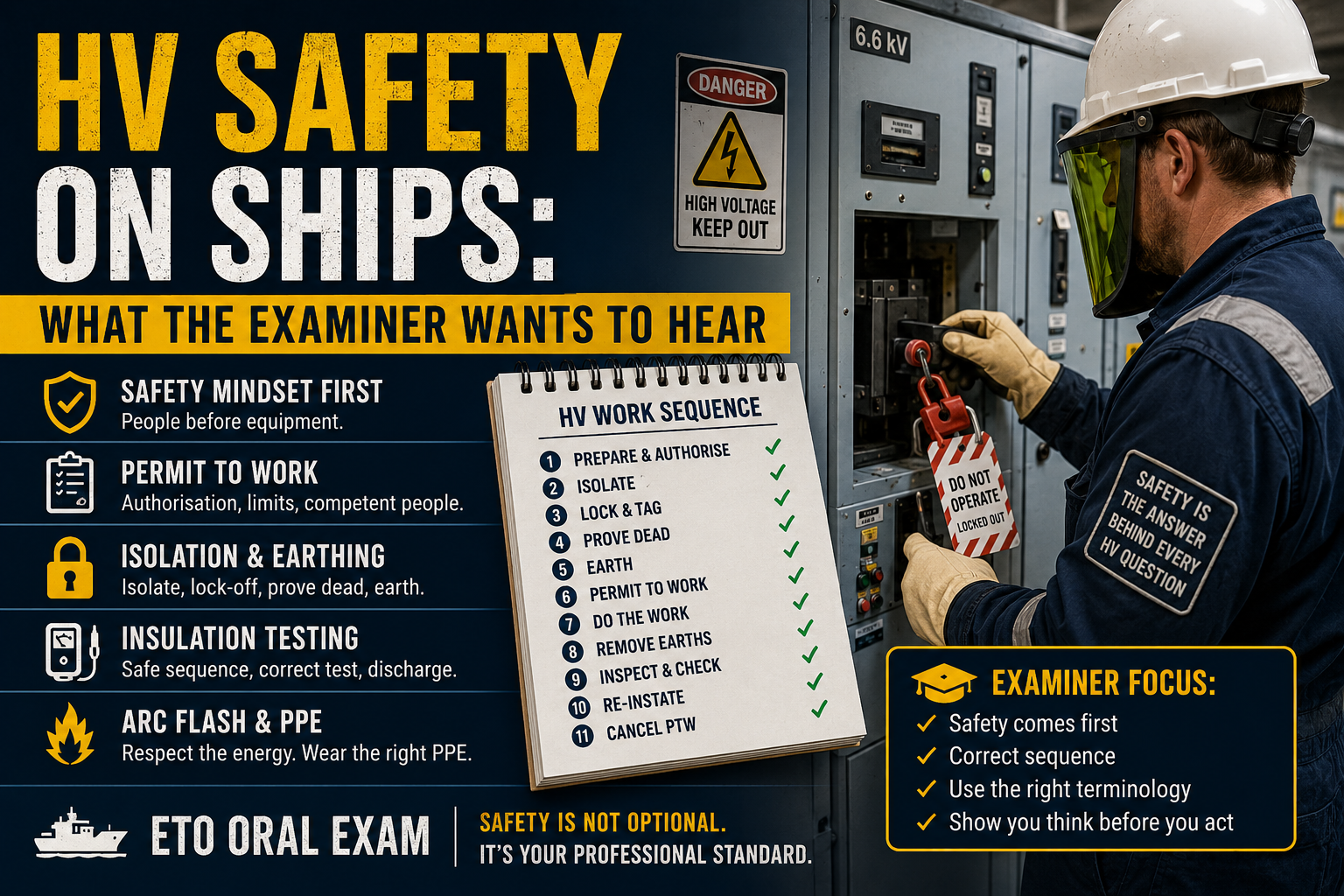

When an examiner asks about high voltage safety on a ship in the ETO oral, they are listening for one thing above all: a safety mindset. The technical detail matters, but what reassures an examiner is hearing that, faced with HV, your instinct is to protect people first. Here is what that sounds like — and what the examiner wants to hear from you.
High voltage safety on a ship: the answer behind every HV question
HV does not forgive mistakes. The examiner knows it, and they want to know that you know it. Whatever the specific question — testing, switching, fault finding — frame your answer so that isolation, permits and earthing come before the task. That ordering alone tells the examiner you think like a safe engineer.
The Permit to Work is not paperwork — it’s protection
Never describe HV work without mentioning the Permit to Work. It is the formal authorisation that confirms the right person has checked the isolation and earthing, defined the limits of the job, and authorised only competent people to proceed. If you treat the permit as a real safety control rather than a formality, you are speaking the examiner’s language.
Isolation and lock-off, in the right order
Be ready to walk through it cleanly: confirm the equipment is not required, open the breaker, withdraw it to the isolated position with a visible isolating gap, lock and tag it off so it cannot be re-energised, then prove dead. Locking off is what stops someone else energising the circuit while you have your hands in it. Say that explicitly.
Earthing: making dead stay dead
After proving dead, apply earths. HV cables store capacitive charge, and a system can pick up induced or back-fed voltage. Earthing discharges that energy and keeps the circuit safe to touch for the whole job. Removing those earths is one of your last steps before re-energising — never before the work is finished and everyone is clear.
Insulation testing — done safely
If asked about insulation resistance testing, lead with the safety steps: isolate, prove dead, discharge — then test with the megger at the correct HV test voltage, phase to earth, and discharge again afterwards. The sequence shows you would not connect a test instrument to anything you had not first made safe.
Arc flash and PPE
Show you respect arc flash — the explosive release of energy in an HV fault. The right answer talks about correct procedures, arc-rated PPE, safe distance and remote racking of breakers where possible, so a person is not standing in front of live switchgear during an operation.
The traps that catch candidates
- Describing HV work and forgetting to prove dead or to earth. Both are non-negotiable — never skip them.
- Saying a circuit is “off” when you mean isolated, proven dead and earthed. Be precise.
- Re-energising in your answer before confirming personnel are clear and earths removed.
A free High Voltage demo quiz built around exactly these safety procedures — with the reasoning explained, the way the oral really works.
Official references
- IMO — STCW Convention: the international framework, including Regulation III/6 for Electro-Technical Officers.
- International Electrotechnical Commission (IEC): standards behind marine HV safety, such as IEC 61936 and IEC 61140.
- Directorate General of Shipping (India): the authority that conducts the ETO CoC examination in India.
Related guides
- ETO oral exam: 10 high voltage questions explained
- Marine high voltage interview questions (with model answers)
- Insulation resistance testing on ships
- How to pass the ETO CoC oral exam — advice from a Senior ETO
- Free High Voltage demo quiz
Get the safety mindset right and the HV questions almost answer themselves. Lead with protecting people, give the procedure in order, and the examiner will hear exactly what they are listening for.