

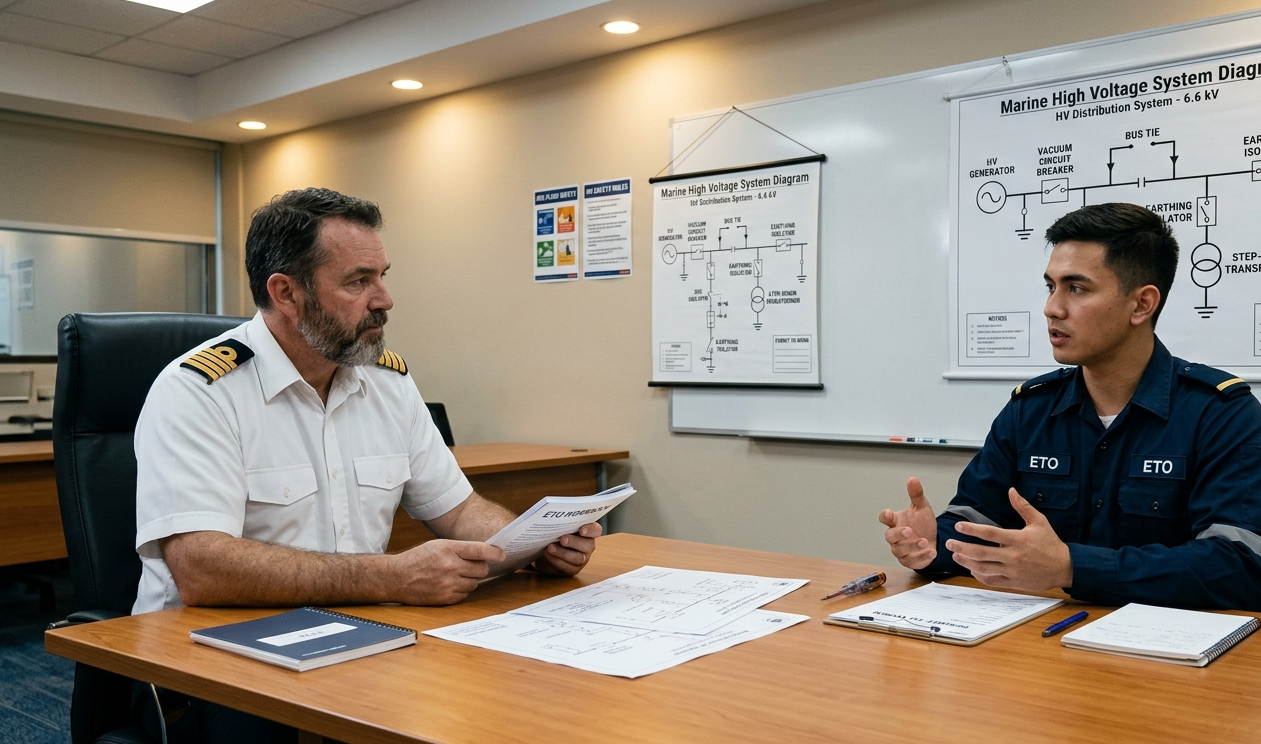

The ETO oral high voltage questions are the part of the CoC oral that makes most candidates freeze. The examiner is not trying to catch you with trick questions — they want to know one thing: are you safe to be left alone near an HV switchboard? Answer from that mindset and most HV questions become straightforward.
Below are ten HV questions that come up again and again in the ETO oral, with the kind of short, safety-first answer an examiner wants to hear. I have kept the answers concise on purpose — in the oral, a clear short answer beats a long story that invites cross-questions.
1. What is “high voltage” on a ship?
Any system above 1000 V AC (per IEC). On ships you will typically see 3.3 kV, 6.6 kV or 11 kV systems. Anything at or below 1000 V is low voltage.
2. Why do ships use HV instead of low voltage?
For the same power, a higher voltage means a lower current. Lower current means smaller cables, lower copper losses and less heat. Large modern vessels — cruise ships, LNG carriers, vessels with electric or podded propulsion — simply cannot distribute that much power at low voltage without enormous cables.
3. Walk me through isolating an HV circuit for maintenance.
This is the question that decides your HV result. Answer it as a procedure, in order: obtain a Permit to Work, confirm the equipment is not required, open the breaker, withdraw/rack it out to the isolated position with a visible isolating gap, lock and tag it off, prove dead, then apply earthing. Never claim a circuit is safe until it is proven dead and earthed.
4. What is a Permit to Work and why is it essential for HV?
A formal, signed authorisation issued by the responsible person before work begins. It confirms the isolation and earthing are in place, defines the limits of the work, and makes sure only authorised people switch HV. For HV it is mandatory — no permit, no work.
5. Why apply earthing after isolation?
To discharge stored capacitive energy in cables and to protect against any induced or back-fed voltage while you work. Earthing makes the dead circuit stay dead and safe to touch.
6. How do you carry out an insulation resistance test on HV equipment?
After isolation, proving dead and discharging, use an insulation tester (megger) at the appropriate test voltage — typically 2.5 kV or 5 kV for HV. Measure each phase to earth, record the readings, and consider the Polarisation Index and temperature. Discharge the equipment again after testing.
7. What is a vacuum circuit breaker and why is it used in HV switchboards?
A VCB interrupts the current and quenches the arc inside a vacuum bottle. It is compact, fast, reliable and needs little maintenance — which is why it is the standard for marine HV switchboards.
8. What is arc flash and how do you protect against it?
Arc flash is the rapid, explosive release of energy during an HV fault — extreme heat, light and pressure. Protection means correct switching procedures, arc-rated PPE, keeping safe distance, and remote racking of breakers where possible so you are not standing in front of the switchboard during operation.
9. How is the neutral of a marine HV system usually treated?
Most marine HV systems use a high-resistance earthed neutral. This limits earth-fault current, allows the system to keep running on a single earth fault while it is located and cleared, and avoids a sudden blackout.
10. What checks do you make before re-energising?
Confirm the work is complete and all personnel are clear, remove the earths, remove locks and tags as per the permit, verify insulation, close up, and energise in the correct sequence. The permit is only cancelled once everything is back to normal.
ETO oral high voltage questions: the fastest way to prepare
Reading answers is not the same as being able to say them under pressure. The best preparation is to practise answering HV questions out loud, then check yourself. That is exactly why I built a free High Voltage demo quiz — real exam-style questions with the reasoning explained, so you train both the answer and the why behind it.
Exam-style HV questions with answers explained by a Senior ETO. No payment, instant feedback.
Official references
- IMO — STCW Convention: the international framework, including Regulation III/6 for Electro-Technical Officers.
- Directorate General of Shipping (India): the authority that conducts the ETO CoC examination in India.
- International Electrotechnical Commission (IEC): standards behind marine HV systems, such as IEC 61936 and IEC 61140.
Related guides
- How to pass the ETO CoC oral exam — advice from a Senior ETO
- Marine high voltage interview questions (with model answers)
- Insulation resistance testing on ships
- HV safety on ships: what the examiner wants to hear
- All free ETO & HV demo quizzes
Prepare with the safety-first mindset, keep your answers short and structured, and the HV part of your oral stops being the scary one. Good luck — you’ve got this.