

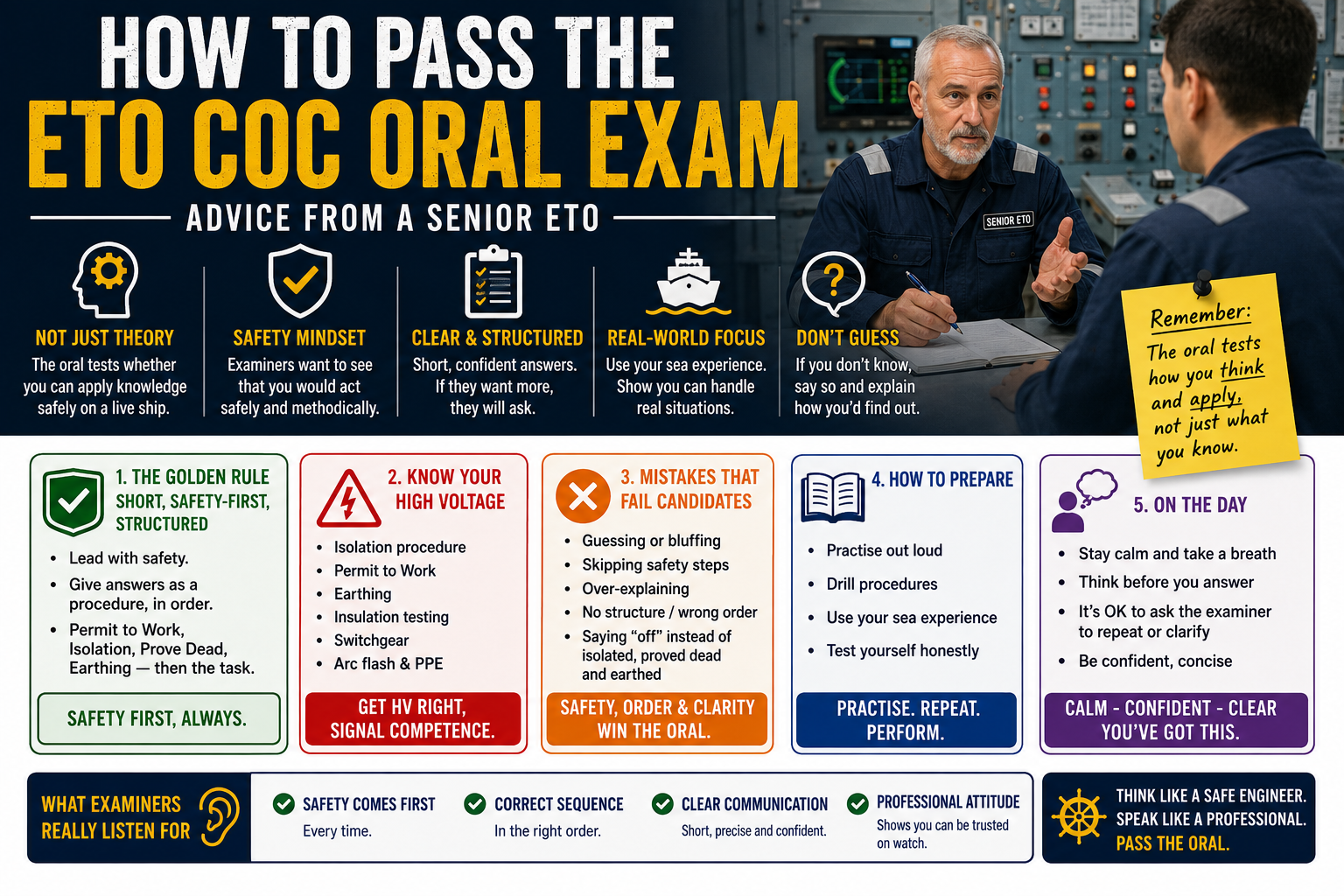

I have sat on the other side of enough conversations to know what separates the candidates who walk out of the ETO CoC oral smiling from the ones who have to go back. It is almost never raw knowledge. It is how you carry yourself and how you answer. Here is the honest advice on how to pass the ETO oral exam that I give every candidate who asks me how to prepare.
Understand what the oral is actually testing
The written exam tests whether you know the theory. The oral tests something different: whether you can be trusted to apply it safely on a live ship. The examiner is picturing you alone in the engine control room at 3 a.m. with a fault on the board. Every answer you give should reassure them that you would act safely and methodically.
The golden rule: short, safety-first, structured
The single biggest mistake candidates make is talking too much. A long, rambling answer does two things: it shows you are unsure, and it hands the examiner more things to cross-question. Give a clear, confident, short answer. If they want more, they will ask.
When a question involves doing something on equipment, answer as a procedure in order, and lead with safety: permit to work, isolation, prove dead, earthing — then the task. Examiners love a candidate who reaches for safety first by instinct.
Know your High Voltage cold
If there is one area that decides ETO orals, it is High Voltage. Isolation procedure, permit to work, earthing, insulation testing, switchgear, arc flash. If you can walk through isolating an HV circuit calmly and in the right order, you signal competence instantly. If you fumble it, the examiner gets nervous — and a nervous examiner asks more questions.
Common mistakes that fail candidates
- Guessing. If you do not know, say so honestly and explain how you would find out (manuals, drawings, asking the Chief). That is a safe answer. Bluffing is not.
- Skipping safety. Jumping straight to “I’d open the panel and…” without mentioning isolation is an instant red flag.
- Over-explaining. Long answers invite cross-questions on details you did not need to raise.
- No structure. Procedures given out of order suggest you have memorised words, not understood the work.
How to pass the ETO oral exam: prepare in the weeks before
- Practise out loud. Reading silently feels productive but does not train speaking under pressure. Say your answers aloud, ideally to someone else.
- Drill the procedures. Isolation, permit to work, parallel operation, fault finding — know the steps in order so well you could recite them tired.
- Use your own sea experience. When you can, anchor an answer to something you have actually done on board. It is far more convincing than textbook recall.
- Test yourself honestly. Use exam-style questions and mark yourself hard. Where you hesitate is where you study next.
On the day
Stay calm, take a breath before answering, and do not rush. A short pause to think reads as confidence, not weakness. If you do not understand a question, it is perfectly acceptable to ask the examiner to repeat or clarify it.
Free ETO and High Voltage demo quizzes — exam-style questions with the reasoning explained, so you train the answer and the why.
Official references
- IMO — STCW Convention: the international framework, including Regulation III/6 for Electro-Technical Officers.
- Directorate General of Shipping (India): the authority that conducts the ETO CoC examination in India.
Related guides
- ETO oral exam: 10 high voltage questions explained
- How to pass the ETO oral exam: a Senior ETO’s method
- ETO oral exam questions: the HV topics that catch candidates
- HV safety on ships: what the examiner wants to hear
- All free ETO & HV demo quizzes
Knowledge gets you to the oral. Calm, safe, structured answers get you through it. Prepare that way and you will be fine. Good luck.