

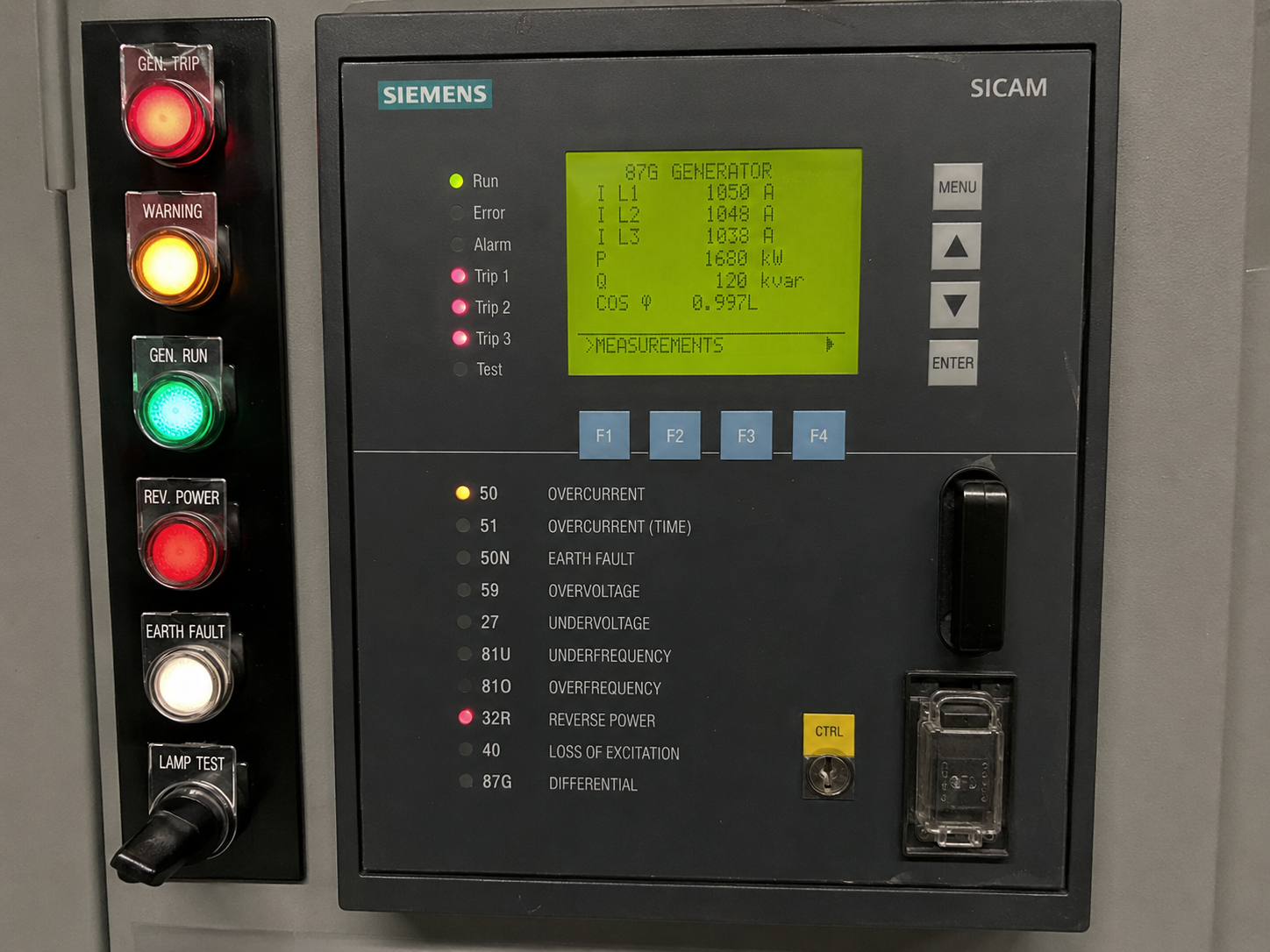

“What protections does an alternator have?” — and then, almost always, “tell me about reverse power.” This pair is a staple of the electrical oral, and the examiner is checking whether you can connect each protection to the failure it guards against. Here is the pass-level answer, the reasoning, and the mistakes that fail people.
The pass-level answer
“The main protections are reverse power, overcurrent and short circuit, earth fault, over- and under-voltage, over- and under-frequency, and on larger machines differential protection and loss-of-excitation. Reverse power is the one examiners focus on: it trips the breaker if the generator stops generating and starts drawing power — motoring — which would otherwise damage the prime mover.”
The reasoning behind it
- Each protection guards a specific failure: reverse power protects the engine; overcurrent protects against overload and faults; earth fault protects against insulation breakdown.
- Reverse power matters most in parallel. If one engine slows or loses fuel, the others would drive it as a motor — the relay trips it off before damage.
- Loss of excitation lets the machine draw reactive power from the others and overheat — hence its own protection on larger sets.
How the examiner pushes
“When does reverse power actually happen?” Most often when paralleled and one prime mover loses power — fuel, governor — so the healthy sets motor it. It can also occur on a faulty shutdown sequence.
“What’s a typical reverse-power setting?” Low — around a few percent of rated power — enough to detect motoring without nuisance tripping on normal load swings.
“Why a time delay on reverse power?” To ride through the brief power reversal that can happen at the moment of synchronising, so it only trips on a real, sustained reverse power.
Mistakes that fail this question
- Listing protections with no reasoning. Reciting names isn’t understanding; tie each to the failure it prevents.
- Not explaining what reverse power protects. The point is the prime mover — miss that and the headline answer is hollow.
- Not linking reverse power to parallel operation. It’s where the fault lives; ignoring it shows a gap.
Related
- Insulation resistance testing on ships: beyond the megohm number
- Marine high voltage interview questions (with model answers)
- ETO oral exam: 10 high voltage questions explained
Coming soon
The Full Electrical Oral System
15 oral scenarios like this one — the pass-level answer, the reasoning, the examiner’s follow-ups and the mistakes that fail you — covering generators, AVRs, earth faults, motors and high voltage. Each verified by a working Senior ETO. Join the list to get it first, at the launch price.
Written by a working Senior ETO with 15+ years on high-voltage container ships. For exam preparation and general guidance — always follow your vessel’s procedures and your flag state’s requirements.